Tolls: you can beat the queues
If heading south, it's best to avoid driving via Paris as traffic can be heavy, unless of course the capital city is part of your trip.
The quickest way to travel between regions and cities when driving in France is via motorways. Take plenty of change with you as you might have to pay motorway tolls at automated barriers. Alternatively, you can buy an Emovis Tag, which enables you to use the automated lanes without the hassle of manually paying with Euros. The fee is exactly the same but payment will automatically be taken from your chosen bank account in GBP.
Exclusive LeShuttle offer
Buy an Emovis Tag and beat the queues at the French motorway tolls:
- Apply for free - no fee (save €10)
- Save 50% on the annual fee, only €4 (normally €8) from the second year of subscription
- €20* refundable security deposit on the tag
- €5* active usage fee - only for the months in which the tag is used and capped at €10 in any subscription year
Apply for your Emovis tag
*Subject to French VAT
Rules of the road
Don't be intimated by roundabouts. The rules are the same as in the UK except you drive in the opposite direction. When approaching a roundabout, give way to traffic on your left already on the roundabout.
Overtaking: Driving on the right and overtaking on the left is the general rule in France. However, overtaking on the right is allowed in lane traffic when there are slow moving lanes. On steep hills, vehicles travelling downhill must give way to those coming uphill. Vehicles may overtake trams in motion on the right only; only on one way streets is it permitted on the left if there is not enough space on the right.
Use of the horn: Horns should only be used to provide necessary warnings to other road users. Between sunset and sunrise, flashing lights should only be used to communicate with other drivers. The horn is only to be employed in emergencies. Within urban areas, use of the horn is prohibited except in incidents of imminent danger. Multi-tone horns, sirens, and whistles are strictly forbidden in France.
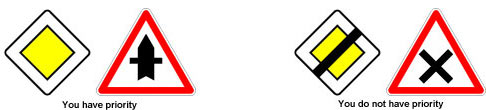
Priorité à Droite (give priority to traffic coming from the right) is an old rule which may still apply at some junctions. If you see the yellow diamond with a white border sign then Priorité à Droite does not apply to the road ahead. Although many drivers now realise it's dangerous to pull straight out into a road of oncoming traffic, keep your eyes peeled for vehicles appearing from the right. The rule is usually indicated as you enter or leave an area:
Speed limits in France
a: Urban areas: 50 km/h
b. Rural areas: 80km/h - 90km/h
c. Dual carriageways: 100 km/h - 110 km/h
d. Autoroute: 110 km/h - 130 km/h
Remember, there are heavy fines for breaking the limits. You will be fined €135 and points added to your licence. If you are over the speed limit by 30km/h you can lose your licence and your vehicle can be confiscated if you are over the limit by 50 km/h.
Driving penalties and fines
Fines can be issued immediately by some French police authorities. Each regional force will have different rules. Drivers can get reduced fines if payment is made in less than three days, as long as the offence does not involve license loss, suspension or a custodial sentence. Court hearings must be requested in 30 days if drivers seek to contest any fines.
Drivers from overseas who commit serious offences, and do not have employment within France, may need to provide a deposit as a guarantee. Vehicles can be retained by French police until such payments are made.
The minimum fine in France is €11, rising to €750. If paid earlier they can be reduced, but can be increased for non-payment (there is usually a 45 day limit).
Can my car be confiscated in France?
Yes, for some driving offences your vehicle can be impounded. This might be in addition to a fine or custodial sentence. Some of the offences include:
- Breaking the speed limit by more than 50 km/h
- Drink driving (repeat offence)
- Refusal to stop when requested
- Driving without insurance or licence
- Driving with the wrong category of licence
Traffic lights
In France the standard three colour light system operates, but there are some differences with the UK. There is no hard amber light after the red light, but a flashing amber light. This means drivers should be cautious, slow down or proceed but give way to vehicles coming from the right.
A flashing red light indicates no entry. It may also indicate a level crossing or exit used by emergency vehicles.
If a red light is accompanied by a yellow arrow, you may proceed in the direction indicated by the arrow, provided you give way to vehicles travelling in that direction, as well as to pedestrians.
Emission Laws in France
If you are planning on driving in France, especially within cities, you should consider getting a Crit’Air sticker for your car. These are Air Quality certificates which indicate the emissions level of your vehicle and are important requirements for driving in France. They are mandatory when driving in low emissions zones in some French cities, including Paris and Lyon.
It is important to check which cities have these zones and whether your vehicle qualifies for a Crit’Air sticker – some may be too old and so you won’t be able to drive in low emissions zones. It can take up to 6 weeks to apply for a certificate so make sure you factor this in before you travel.
Find out more about emissions laws in France
Ready to refuel?
You'll find motorway service stations manned around the clock so you can fill up your tank. Prices are often cheaper at supermarkets petrol stations though so it's worth scheduling in a stop. Many fuel stations have automatic pumps where you can pay using 'chip and PIN' UK credit or debit cards.
When I get to the pumps, how will I know which one I need? Well, you're likely to see these options...
a. Petrol = Essence (super / super 97)
b. Unleaded Petrol = Sans Plomb (98 & 95)
c. Diesel = Gazole ou Gasoil
Parking rules
It is usual practice in French towns to allow parking on one side of the street for half of the month and then on the other side for the second half of the month. Parking may also alternate weekly or daily.
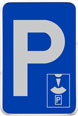 Parking is free on roads with a dotted white line or no markings. Blue zone parking areas allow free parking for a designated time. You'll need to display a parking disc in your vehicle window showing your arrival time. Look for the parking sign in the area to find out the length of time you're permitted to stay. You can pick up a new parking disc at newsagents or tobacconists and failure to display the new disc could result in a fine. Blue parking zones are shown with a parking sign with a cryptogram in the bottom corner as in the example shown here.
Street parking in Paris is limited as many roads are pedestrianised and it's illegal to park your vehicle for longer than 24 hours in the same spot.
Car insurance and motor breakdown
You must have third party insurance cover (a legal requirement) at the least when driving in France, but it doesn't cover any costs incurred by you as a result of an accident. Make sure your policy is fully comprehensive and that you have your Certificate of Motor Insurance before setting off.
You do not need to carry a green card when you drive in the EU (including Ireland), Andorra, Bosnia and Herzegovina, Iceland, Liechtenstein, Norway, Serbia, and Switzerland. You still need valid vehicle insurance. For more information visit driving abroad on Gov.uk.
Vehicle repatriation from Southern France could cost up to £1,300(4) . With that in mind we recommend that you have sufficient motor breakdown insurance cover in place in case anything happens while you are away. We offer comprehensive travel insurance packages for you and your vehicle.
Lights
It is advisable to use dipped headlights at all times outside towns in any weather. Dipped headlights must be used in poor daytime visibility. Motorcycles over 125cc must use dipped headlights during the day at all times. For motorhomes and caravans, lights must be used at all times when travelling in tunnels or in bad weather.
Drink driving
The drink driving in France rules are strict. The limit is 50mg of alcohol in 100ml of blood. It is advisable not to drink and drive at all because if you are caught over the limit, the penalties are severe. You will be fined €135 if you are over the 50mg limit. If you have more than 80mg of alcohol in your blood you could be fined up to €4,500 and banned from driving for three years.
Random breath tests
Don’t be surprised to find yourself being stopped by French police and being asked to take a breath test. Random breathalyser tests are commonplace on French roads, with drivers 20 times more likely to be tested in France as on the UK’s roads. Tests always take place after an accident in which someone has been injured or there has been a serious motoring offence.
Hiring a car
If you’re hiring a car in France, some rules will be different.
- You need to be 21 to hire a car, although this may vary depending on the type of vehicle
- Rental companies will need to see your full, valid UK driving licence (held for a minimum of 12 months) and second proof of ID
- Provide a credit card as a deposit
- Check with your hire company which countries you can drive into from France
- Have car hire excess insurance in place
Emergency phone network
Motorways in France have emergency telephones every 2km along the road. These are part of an SOS phone network.
If you can’t get to one of these phones, or you need immediate assistance in an emergency, dial 112 on your mobile phone and you can speak to the emergency services. Language won’t be a problem, as the operators will be able to speak to you in English.
When driving in France, what do you need?
Here's your checklist for the requirements for driving in France:
| Minimum Legal Driving Age |
18 |
| National Driving Licence |
Compulsory |
| Original Registration Document (V5) |
Compulsory |
| Motor Vehicle Insurance |
Compulsory |
| Front & Rear Seatbelts |
Compulsory |
| UK Sticker(1) |
Compulsory |
| Warning Triangle |
Compulsory |
| Reflective Jacket(2) |
Compulsory |
| Headlamp Adjustment(3) |
Compulsory |
| Daytime Running Lights - Motorcycles |
Compulsory |
| First Aid Kit |
Recommended |
| Fire Extinguisher |
Recommended |
| Daytime Running Lights - Cars |
Recommended |
| Spare Bulbs and Fuses |
Recommended |